Wednesday, February 29, 2012
Ball Jar Nation
"You remember the Nineties, when everyone was pickling their own vegetables and brewing their own beer? People were growing out their mutton chops and waxing their handlebar mustaches."
"The Nineties?"
"Yeah. Everyone was knitting and sewing clothes for their children. People were wearing glasses all the time like contact lenses had never been invented."
"Wait, are we talking about the Nineteen Nineties?"
"No — the Eighteen Nineties."
This video is so relevant to my culture it hurts.

Tuesday, February 14, 2012
"Let's talk about definitions": ORE, a site-specific performance
The clouds hung over us like lead as we laid the set: tarp up against the sandy walls, benches on the sandbank for the audience, sound system in the ravine. Light rain flitted about. As I piled on layers and tried to warm up I wondered if I could even dance in these conditions. The arroyo where we'd been building this dance for six weeks had turned hostile.
This is one of the hazards of site-specific performance -- but one of its thrills, too. Because 10 minutes before our figurative curtain went up, the clouds broke and the high mountain sun tipped the mercury this side of bearable. A crowd bigger and more varied than we expected turned out, and as we began our show I noticed how the rough weather had only immersed me in the site more deeply.
This is ORE, a site-specific dance and theater piece I collaborated on with the wonderful Sarah, Miles, Áine, Eric, Adam. I hope you enjoy watching it as much as I did making it. Special thanks to Eric and Monique for the documentation.
For a little more background, check out Sarah's write-up of the piece.
ORE Part I from Sarah Ashkin on Vimeo.
ORE Part II from Sarah Ashkin on Vimeo.
Friday, December 16, 2011
dilapa-dome diaries: how many nights were you outside this year?
As I lay awake I counted up how many nights I slept outside this year. Two in Joshua Tree, the coldest nights I've ever spent. Four in Hueco Tanks, TX, where 45 mph winds turned one side of my tent permanently convex. Will dubbed it the Dilapa-dome. We mimed beta in our sleep and woke with burning hands. I spent strings of nights on the road, steaming swamps in Louisiana and pine forest in North Carolina. I mastered the pitch'n'ditch, pulling in late and lighting out before anyone came around to collect fees. Should I be ashamed, or proud? Neon and damp grass at Yogi Bear Mini Golf Camping, a lightning storm on the dark New Mexico horizon. The bulk of nights I spent with Áine on a farm in Italy, where the tent's slope gave us two choices: crawl uphill while we slept, or rest in the damp crease of the downhill door. It was worth it to look across the valley at the Dolomites every morning. In the Whites I slept solo, every yawing tree a bear.
Thirty-two nights. Not counting the nights in the Fun Finder trailer, or the ones in Zealand Falls Hut. Thirty-two nights in a tent. None of them under the bare stars, none of them far from a car. Thirty-two nights, a month of tent living.
I look forward to besting it next year.
Friday, December 9, 2011
it's not a place, it's a state of mind

This time of year, with darkness falling in the afternoon and a body longing for the warmth of the hearth, I can't help but think of 175 Lincoln St., Middletown, CT 06457. I lived there my last two semesters of college, nine glorious months. As finals approached and the Connecticut winter began to clench its fist it was such solace to find Eric baking up some bread, or Arielle toting cider to brew, or Abe jamming in the basement. Or this bear, which showed up on the toilet of our basement bathroom courtesy of some mischievous friends.
So throw a winter squash in the oven and raise your highlife/PBR/blue moon/cider/fancy Weshop drink. Happy December to the residents of that noble abode, past, present, and honorary.
More photos of the Lincoln St. lifestyle after the jump.
Friday, December 2, 2011


Friday, November 11, 2011
I'm up at 2:30 a.m. — way, way later than I've stayed up in front of my computer since finishing school. Anxious. Because I'm jobless. The handful of job applications I've submitted since being back in the states have turned up not rejections, but worse: a response-less void. Every time I open my email I cross my unconscious fingers that there will at least be something. The aether into which they've apparently disappeared disheartens. It's not even a question of money, per se, and I'm thankful for that. There's a little cash flowing from taking care of two boys a few days a week and subbing at my old post behind the pastry counter at the Farmers' Market. But not having a "job" — you know, like a like job job — leaves me feeling aimless.
Luckily I have a kick-ass community of friends and fellow artists. In two days a performance I helped create goes up: ORE. The process has left me reverent for the river arroyo where we've been working, for the echoes of weather and geology that sound there every day. I can't wait to have eyes on the movement and theater we've put together.
When that's over I'm headed to Indian Creek, hallowed ground for the practice of delicate vertical play we call crack climbing. How to ascend these featureless fissures? A climbing wandered once advices me with the koan, "Find the void, and fill it." The purity of red rock, blue skies, camp cooking, and old friend Eric. I'm already savoring the memories I haven't even made yet.
So you see, as we get deep into the month culminating in gluttony and gratitude, I have much to be thankful for. Regardless of employment.
Besides, I've got two fail-proof businesses in the works: granola bars and wool hats. More soon.
Thursday, November 3, 2011
Nesting
I've been back in Santa Fe for two weeks now, and once Á and I set up the apartment the next step was clear: stock the larders. So now there's Kombucha brewing in the cupboard, chicked stock simmering on the stove, beans and rice and popcorn and other bulk goodies overflowing a drawer, and a pot of black bean stew ready for slurping in the fridge.
The freezer is a study in opportunism. Fire sale on overripe bananas = frozen baggies of banana puree. Jesse overestimates how many bulk garlic cloves she needs to make prosciutto = trays of frozen minced garlic. Green chile sold by the bushel = 33 serving baggies of it, skinned and cleaned and ready to serve. Not to mention the pints of cooked black beans or the leftover pumpkin pulp awaiting some kitchen magic.
Ah, the joys of nesting. The prepared shall inherit the earth? Nah, but they will get to eat tasty meals every single day.
Sunday, August 21, 2011
ignore the last post, we have a tumblr instead
Aine didn´t quite know what twitter was, so we made a tumblr instead. Find it at pandapilgrims.tumblr.com.
Wednesday, August 10, 2011
pilgrimage + modernity = twitter
Áine and I are twittering* on this pilgrimage. Follow us at PandApilgrims — that's panda pilgrims to you!
* (I know the verb is "tweeting" but I like this more)
* (I know the verb is "tweeting" but I like this more)
tomorrow I start walking
"We learn a place and how to visualize spatial relations as children, on foot and with imagination. Place and the scale of space must be measured against our bodies and their capabilities. A 'mile' was originally a roman measure of one thousand paces. Automobile and airplane travel teaches us little that we can easily translate into a pereption of space. To know that it takes six months to walk across Turtle Island/North America walking steadily but comfortably all day every day is to get some grasp of the distance. The Chinese spoke of the 'four dignities'—Standing, Lying, Sitting, and Walking. They are 'dignities' in that they are ways of being fully ourselves, at home in our bodies, in their fundamental modes. I think many of us would consider it quite marvelous if we could set out on foot again, with a little in or a clean camp available every ten or so miles and no threat from traffic, to travel across a large landscape—all of China, all of Europe. That's the way to see the world: in our own bodies."
- G.S., "Blue Mountains Constantly Walking"
- G.S., "Blue Mountains Constantly Walking"
an open letter to our wwoofing host
Dear Paola,
Thank you for hosting Áine and I at your garden for the last two and a half weeks. I just wanted to offer a few constructive criticisms regarding our time there. Specifically, I want to talk about your management style, and your tone regarding the language barrier.
I wonder if you're situation is very appropriate for WWOOFers. Your whole property is beautiful, of course, and I loved waking up in our tent on the hill and watching the clouds move through the Dolomites across the valley. The land's steep slope tired out my legs, but it was good training for our upcoming pilgrimage on the Camino de Santiago. What makes me wonder how well WWOOFers can fit into your garden, though, is how idiosyncratic your gardening methods are. Your garden seemed to me a disorganized, haphazard collection of vegetables and some plants I didn't know. Though it's not big — a quarter acre? — it took me half my time there to find the pond in the middle. The thing is, your garden may have been an intricately inter-cropped ecosystem, each plant quite functional — but since you didn't give me any orientation within the garden, I saw no order and was consistently confused when you asked me to do any task in there. Where were the nasturtium I was supposed to pick? All the carrots I could find for lunch were tiny; was there another patch with full-sized ones?
Outside the garden, on the hillside you had us clearing, your vision was even less clear. Sometimes you were maddeningly vague. "Build a compost toilet," was one job. "Make a gate out of this scrap fencing," was another. You would give desultory instructions and sometimes bring tools or materials, but the fence ended up being built by your husband and son in an entirely different way (for which I'm happy). Other times you were overly finicky about how things were done, but wouldn't explain the specific way you wanted something done until after I'd been at it for an hour. When you discovered my errors you acted as though I had wasted your time; really it was a waste for us both. Miscommunication and error are to be expected in a WWOOFing arrangement, since you're having new workers every week or so. If you're going to be continuously disappointed, maybe WWOOFing isn't for you.
Miscommunication underlay many of the difficulties on the farm, which makes sense because there was a huuuuge language barrier. You speak only a few words of English (the most memorable of which are, "Ees no good!" every time I did anything...) And Áine and I speak an eensie-weensie bit of Italian. As we noted in our letter to you, we spoke little Italian and were WWOOFing in part to learn some of your language. (Actually, the prospect of gaining the basics of a new language convinced me to WWOOF after years of skepticism).
Now, the language barrier is a doozie. We've been butting up against it the whole time we've been in Italy. Áine has been better than me, tucking words and phrases away to bust out. While we worked in your garden she would listen to Italian langauge lessons on her iPod, booming out Italian phrases into the tomato patch she was weeding. But once we were inside, all the slight, mood-lightening conversation she tried to make only seemed to stress you out. During meals I would stare at my soup to avoid all but the most crucial communication. At its best the language barrier can be an ongoing comedy of errors, kindergarden meets charades. But on your watch it was a constant energy drain. The last days of our time in the garden drove this home: you went on vacation and left the house in care of your sister. With her warmth and understanding, we spoke more in two days with her than we did in two weeks with you, and surprised ourselves at how well we could communicate.
I'm sorry if this letter is a bit harsh. You don't read English, of course, and I'm not going to tell you about it, so it's more for me to let go of a mediocre three weeks than to actually have you change anything about your situation for future WWOOFers.
I was not a very good worker on your farm. When it seems impossible to please the person you're working for, when it's clear they don't trust you, you're not moved to do good work. I cut corners when I could, taking extra trips to the house, long snack breaks, moving slow. I'm not proud of the work I did, and can only hope that your next WWOOFers can perform their tasks to your satisfaction and, perhaps, break the cycle of mistrust that existed between us.
sincerely,
Paolo
sincerely,
Paolo
regarding handtools

I am conflicted about the scythe. I see it as the opposite of the weed-whacker, that foul, noisy machine that wrecks my body, emits noxious gas, and makes me feel like a soldier. With a handtool I feel like just one part of the ecosystem. Instead of the capital being in a machine, I gain human capital by learning a technique. I exercise a pit. The handtool requires less infrastructure, just a whetstone, while the machine requires gas, oil, and a mechanic. The scythe may be less efficient, but the equation looks different when you consider how long one spends fixing the weed-whacker. Scything, I want to someday clear land as efficiently as a weedwhacker, but come out calmer at the end of the task than I would with the machine.
This "someday" musing has been a big part of WWOOFing. Getting exposed to many tools, techniques, and farms is a good way of seeing what works and what doesn't. And it gets me thinking about whether I'd want to be a full-time farmer someday. (Is a piece of good land within walking or biking distance of climbing too much to ask?)
So, would I use a scythe on my own field? When I'm WWOOFing, opting for the scythe over the weed-whacker is an obvious choice because I'm doing a set number of hours of work. But if I'm trying to clear land for myself, would I just get a weed-whacker? I've used well-designed and powerful ones, back-wrecking slow ones, and one that was so chintzy it was almost disposable. The most solid scythe is less expensive than the crappiest weed-whacker. Could I rely on the rhythm and "flow" that's possible (but far from inherent) in the handtool? Or is it best just to beast it out with a weed-wacher? I feel so alienated by the machine.
There are other considerations, of course, like how much land I'm clearing and how often I have to do it. And the scythe is plenty hard on my body, too. The steep land at Paola's farm is killer on my back, which ached all morning. When I finally rested it at siesta it seized up. Painful! Doesn't seem sustainable. Scything, like so many things that give me "flow," can either be beautifully focussed, or injurious.
Plus there's the question of whether electing to use handtools is a bit precious, a bit for the hoity-toity farmer. Or it could be a way of keeping overhead low and not going into debt. If it's part of a mindfully-run system, I wonder if it could work, leaving everyone calmer and happier that using a machine.
one evening
From Friday, July 22, 2011:
I never used a scythe until today. Evening saw Áine and me on the slope just outside the garden fence, mowing the tall grass with these curved blades. The thrush, thrush, thrush of falling stalks, a pause for breath or to wipe sweat from a brow. Áine worked on the slope below me, haloed by the late light as the song of us, thrush, thrush, moved cross the hill. Sun sank, playing in the clouds heaped in the mountains across the valley. The field at my feet was a miniature rain forest, worlds of insects hopping in a hundred direction with every swing of the blade. Thrush, thrush, thrush. "Doing this, you see how destruction can be satisfying," Áine said. Thrush, thrush. Our host farmer, Paola, had snapped off the head of each stalk, gathering the season's grain. The bare stalks now fell before us, until her son Andrea came up yelling, "Dinner ees ready!"
Later, with the mowing was done and my belly full of pasta, I went out to get my sleeping sack off the clothesline. Above the steep slope of the garden, a cloud mountain glowed white. Sun long since down, it was star time, a time no white should still be. White as if lit by moonlight. Then it pulsed. Lightning lit the cloud from inside like a heartbeat. Internal relief of billows and curves. No thunder I could hear, just rustling corn. The cloud beat with silent light, a self-contained world of — "electric storm"? I didn't even know the name for what I watched so long, laundry forgotten in hand. After a long time I apprehended that it was expanding. With slow force, like plate tectonics, like breathing, it built itself. I climbed further up into the garden to look at the mountains. Dark clouds blocked them, but in the valley there were human lights. Turned once more the the silent brilliant storm and, in gratitude, came in.
Thursday, July 28, 2011
to recap:

In Florence we added arugula to street pizza

and to goat cheese gelato.

We saw some fancy scientific instruments,

then left Florence for The Leaning Town of Pisa and its Perfectly Normal Tower.

Our traveling companion Catbee held the tower up

and flew over it!
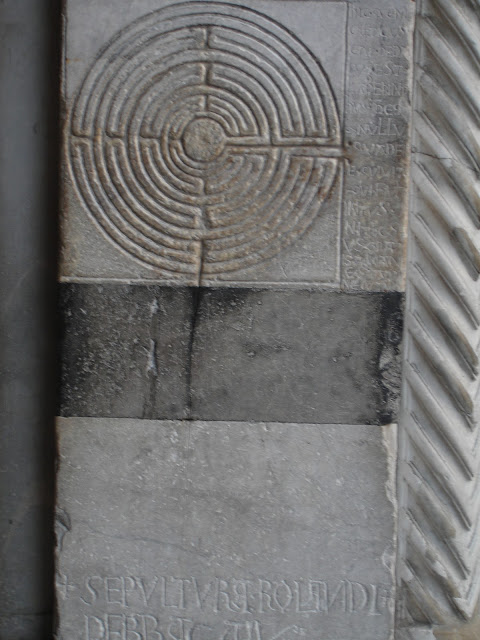
Áine visited a labyrinth in Lucca

and we worked on a farm

picking lettuce

playing with bees

and having a costume party. I say samurai, Áine says Darth Vader. (photo by Á).

Our host Vanessa with her bees.

The farm was in the town of Castelvecchio, a medieval villa.

Bells from towns throughout the valley tolled the hour.
We parted ways. I went to meet a long-lost relative (more on that later),

while Áine hiked her legs off at the Amalfi Coast (photo by Á)

A fish swimming the labyrinth. (photo by Á)
We reconvened in Alvignano, a small town outside of Napoli where Áine's relatives live. No pictures got taken during our three days there — too busy eating, I guess. A special thanks to Angela, Vera, Vincenzo, and both Raqueles for making us feel like royalty.

We climbed Mt. Vesuvius. Áine looked into the crater.
Now, we are on another farm, this one in the mountain country of northern Italy. Milk cartons are German on one side, Italian on the other. When you picture us, picture us in Heidi.
Sunday, July 10, 2011
at the Duomo

photo by Áine
A steady stream of tourists poured onto the Duomo balcony. From the bench we had a better view of them than of the city, so we people-watched. When I'm around tourists my default attitudes are mild embarrassment, condescension, or outright contempt. It's the worst when I'm a tourist myself as I am here, afloat without much knowledge of the place. I came to Italy with only a rough plan, and it feels funny to merely follow the crowds to famous places. But here I was the the top of the Duomo, clueless as anyone.
We sat for awhile, probably an hour. We pointed out landmarks to each other, the domes and spires of the city rising around us like siblings. Kids begged Euros off their parents to play with the binocular viewing machines. People took pictures of themselves deep in shadow, pictures that would probably be washed out by flash. I tried not to worry about it. We watched the light pass from mid-morning glow to noon glare. It got hot. We had our picture taken -- twice, because my shirt was ridiculously unbuttoned the first time. And headed down.
I'm traveling with little knowledge, but also with no expectations. It's liberating, in a way. My itinerary is a mash-up of Áine's recommendations, random guidebook flipping, and mere whim. In a place like Florence I just focus on staying super, super open and observant, smile at the other tourists, and let myself be moved.

a Michaelangelo freak-out
I saw the Sistine Chapel. It was lower than I expected but magnificent in a way I couldn't have imagined, especially when I stood at one end and all the figures popped out (he was a master of perspective).
I saw the David. Even after seeing the two Florence-sanctioned copies of it, it still stunned me. David is poised. And the poise itself is a state of grace.
And I saw Michaelangelo's tomb, in the Basilica di Santa Croce. The tomb is a relatively runty thing, the three statues around it not hardly as good as anything the artist made. Apparently he was making work for his own tomb, but didn't finish before he died. A tragic figure. The picture of Jeremiah on the Chapel ceiling is his self portrait, and the exhaustion and anguish in the prophet's hung face is heartbreaking. Some guidebook told me that Michaelangelo was 80 years old when he died, and sculpted right up to the end.
What made me freak out, though, was the realization that his body is actually there in the marble casket in the corner of Santa Croce. The same bones that held him up as he moved over the chapel ceiling, the same ones that pounded out the David — they were right there, not ten feet from me as I stood before his tomb.

Wednesday, July 6, 2011
the mentality
 (photo by Kiera)
Me: "Four gelatos in a day? That's pushing it."
Áine: "Oh, I've done it."
Me: "That's a lot of money!"
Áine: "Not if you don't buy any other food. Then it's just sustenance."
Subscribe to:
Posts (Atom)