Wednesday, August 10, 2011

regarding handtools


journal entry, July 23, 2011:

I am conflicted about the scythe.  I see it as the opposite of the weed-whacker, that foul, noisy machine that wrecks my body, emits noxious gas, and makes me feel like a soldier.  With a handtool I feel like just one part of the ecosystem.  Instead of the capital being in a machine, I gain human capital by learning a technique.  I exercise a pit.  The handtool requires less infrastructure, just a whetstone, while the machine requires gas, oil, and a mechanic.  The scythe may be less efficient, but the equation looks different when you consider how long one spends fixing the weed-whacker.  Scything, I want to someday clear land as efficiently as a weedwhacker, but come out calmer at the end of the task than I would with the machine.

This "someday" musing has been a big part of WWOOFing.  Getting exposed to many tools, techniques, and farms is a good way of seeing what works and what doesn't.  And it gets me thinking about whether I'd want to be a full-time farmer someday.  (Is a piece of good land within walking or biking distance of climbing too much to ask?)

So, would I use a scythe on my own field?  When I'm WWOOFing, opting for the scythe over the weed-whacker is an obvious choice because I'm doing a set number of hours of work.  But if I'm trying to clear land for myself, would I just get a weed-whacker?  I've used well-designed and powerful ones, back-wrecking slow ones, and one that was so chintzy it was almost disposable.  The most solid scythe is less expensive than the crappiest weed-whacker.  Could I rely on the rhythm and "flow" that's possible (but far from inherent) in the handtool?  Or is it best just to beast it out with a weed-wacher?  I feel so alienated by the machine.

There are other considerations, of course, like how much land I'm clearing and how often I have to do it. And the scythe is plenty hard on my body, too.  The steep land at Paola's farm is killer on my back, which ached all morning.  When I finally rested it at siesta it seized up.  Painful!  Doesn't seem sustainable.  Scything, like so many things that give me "flow," can either be beautifully focussed, or injurious.

Plus there's the question of whether electing to use handtools is a bit precious, a bit for the hoity-toity farmer.  Or it could be a way of keeping overhead low and not going into debt.  If it's part of a mindfully-run system, I wonder if it could work, leaving everyone calmer and happier that using a machine.

one evening

From Friday, July 22, 2011:

I never used a scythe until today. Evening saw Áine and me on the slope just outside the garden fence, mowing the tall grass with these curved blades. The thrush, thrush, thrush of falling stalks, a pause for breath or to wipe sweat from a brow. Áine worked on the slope below me, haloed by the late light as the song of us, thrush, thrush, moved cross the hill. Sun sank, playing in the clouds heaped in the mountains across the valley. The field at my feet was a miniature rain forest, worlds of insects hopping in a hundred direction with every swing of the blade. Thrush, thrush, thrush. "Doing this, you see how destruction can be satisfying," Áine said. Thrush, thrush. Our host farmer, Paola, had snapped off the head of each stalk, gathering the season's grain. The bare stalks now fell before us, until her son Andrea came up yelling, "Dinner ees ready!"

Later, with the mowing was done and my belly full of pasta, I went out to get my sleeping sack off the clothesline. Above the steep slope of the garden, a cloud mountain glowed white. Sun long since down, it was star time, a time no white should still be. White as if lit by moonlight. Then it pulsed. Lightning lit the cloud from inside like a heartbeat. Internal relief of billows and curves. No thunder I could hear, just rustling corn. The cloud beat with silent light, a self-contained world of — "electric storm"? I didn't even know the name for what I watched so long, laundry forgotten in hand. After a long time I apprehended that it was expanding. With slow force, like plate tectonics, like breathing, it built itself. I climbed further up into the garden to look at the mountains. Dark clouds blocked them, but in the valley there were human lights. Turned once more the the silent brilliant storm and, in gratitude, came in.

Thursday, July 28, 2011

to recap:


In Florence we added arugula to street pizza

and to goat cheese gelato.

We saw some fancy scientific instruments,

then left Florence for The Leaning Town of Pisa and its Perfectly Normal Tower.

Our traveling companion Catbee held the tower up

and flew over it!

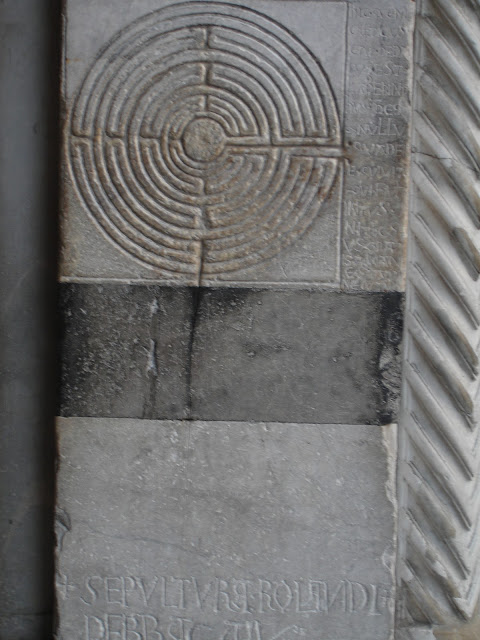
Áine visited a labyrinth in Lucca

and we worked on a farm

picking lettuce

playing with bees

and having a costume party. I say samurai, Áine says Darth Vader. (photo by Á).

Our host Vanessa with her bees.

The farm was in the town of Castelvecchio, a medieval villa.

Bells from towns throughout the valley tolled the hour.

We parted ways. I went to meet a long-lost relative (more on that later),

while Áine hiked her legs off at the Amalfi Coast (photo by Á)

A fish swimming the labyrinth. (photo by Á)

We reconvened in Alvignano, a small town outside of Napoli where Áine's relatives live. No pictures got taken during our three days there — too busy eating, I guess. A special thanks to Angela, Vera, Vincenzo, and both Raqueles for making us feel like royalty.


We climbed Mt. Vesuvius. Áine looked into the crater.

Now, we are on another farm, this one in the mountain country of northern Italy. Milk cartons are German on one side, Italian on the other. When you picture us, picture us in Heidi.


Sunday, July 10, 2011

at the Duomo

photo by Áine

The step wound up through the bowels of the dome, a narrow spiraling course that made me think of the occult. The walls crawled with penned graffiti. Four hundred some steps we climbed that morning, so when we finally popped out on the roof of the Duomo we plopped ourselves down and took a rest. Florence stretched out below us, its red roofs on white buildings thinning out into the green hills at the edges of the city.

A steady stream of tourists poured onto the Duomo balcony. From the bench we had a better view of them than of the city, so we people-watched. When I'm around tourists my default attitudes are mild embarrassment, condescension, or outright contempt. It's the worst when I'm a tourist myself as I am here, afloat without much knowledge of the place. I came to Italy with only a rough plan, and it feels funny to merely follow the crowds to famous places. But here I was the the top of the Duomo, clueless as anyone.

We sat for awhile, probably an hour. We pointed out landmarks to each other, the domes and spires of the city rising around us like siblings. Kids begged Euros off their parents to play with the binocular viewing machines. People took pictures of themselves deep in shadow, pictures that would probably be washed out by flash. I tried not to worry about it. We watched the light pass from mid-morning glow to noon glare. It got hot. We had our picture taken -- twice, because my shirt was ridiculously unbuttoned the first time. And headed down.

I'm traveling with little knowledge, but also with no expectations. It's liberating, in a way. My itinerary is a mash-up of Áine's recommendations, random guidebook flipping, and mere whim. In a place like Florence I just focus on staying super, super open and observant, smile at the other tourists, and let myself be moved.


a Michaelangelo freak-out

I saw the Sistine Chapel. It was lower than I expected but magnificent in a way I couldn't have imagined, especially when I stood at one end and all the figures popped out (he was a master of perspective).

I saw the David. Even after seeing the two Florence-sanctioned copies of it, it still stunned me. David is poised. And the poise itself is a state of grace.

And I saw Michaelangelo's tomb, in the Basilica di Santa Croce. The tomb is a relatively runty thing, the three statues around it not hardly as good as anything the artist made. Apparently he was making work for his own tomb, but didn't finish before he died. A tragic figure. The picture of Jeremiah on the Chapel ceiling is his self portrait, and the exhaustion and anguish in the prophet's hung face is heartbreaking. Some guidebook told me that Michaelangelo was 80 years old when he died, and sculpted right up to the end.

What made me freak out, though, was the realization that his body is actually there in the marble casket in the corner of Santa Croce. The same bones that held him up as he moved over the chapel ceiling, the same ones that pounded out the David — they were right there, not ten feet from me as I stood before his tomb.


Wednesday, July 6, 2011

the mentality

(photo by Kiera)

Me: "Four gelatos in a day? That's pushing it."
Áine: "Oh, I've done it."
Me: "That's a lot of money!"
Áine: "Not if you don't buy any other food. Then it's just sustenance."


Monday, July 4, 2011

...and in global news....

http://www.bbc.co.uk/news/world-us-canada-13985611

Forest fires in the Jemez Mountains northwest of Santa Fe. Big news because Los Alamos had to be evacuated, and "thousands of sophisticated experiments underway at the lab, where the world's first atomic bomb was developed in 1945, remain at a standstill." I hope that everyone I know in the area is safe, that the fires don't explode some experiments into nuclear meltdown, and that access to climbing in Las Conchas is unchanged.

I wonder if the fires will affect construction of the nuclear materials production facility that no one's talking about?

Followers

Powered by Blogger.